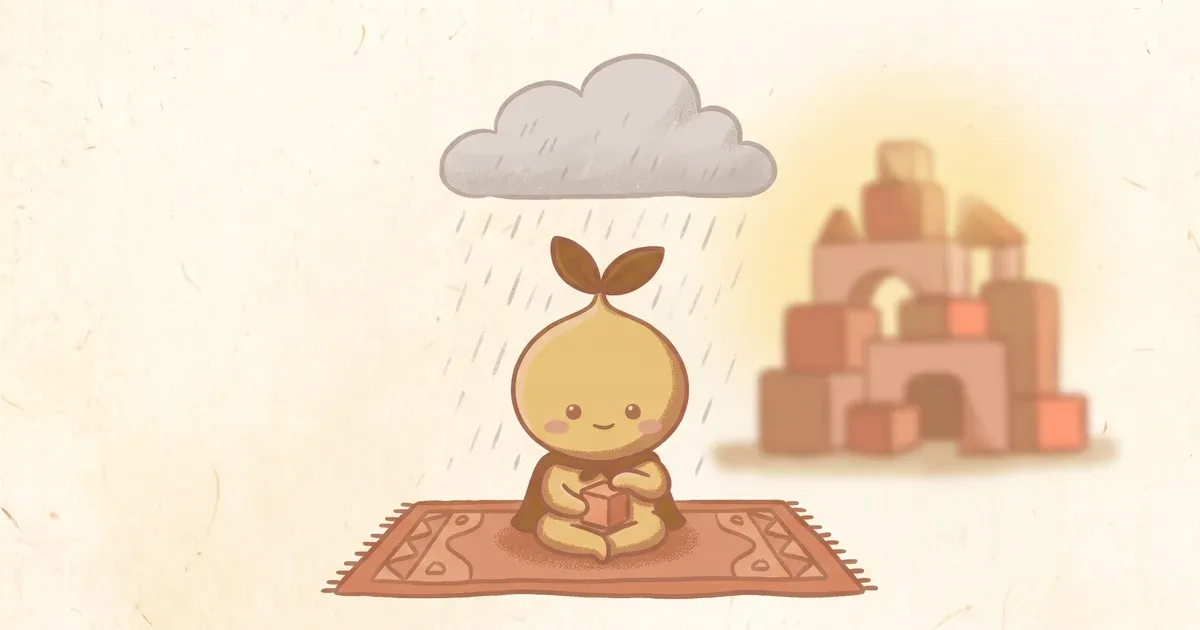
Why habits fail
Most habits collapse around week two not because you're weak, but because they were sized for your best day. Size them for your worst realistic day instead, and they survive every day in between.
Original Nuglet framework
The Bad Day Habit Test
Before you commit, run it through one test.
- 1
Picture your worst realistic day this week: tired, behind, no motivation.
- 2
Could you still do the habit, at its current size, on that day?
- 3
If yes, the size is right. If no, cut it in half and ask again.
- 4
Keep cutting until the answer is yes, even if it feels too small to matter.
Practical experiment
A sizing trial for one week
Pick one habit and size it down before you start, not after it fails.
- Day 1: write the smallest version that survives a bad day, attach it to something you already do daily.
- Days 2 through 5: do only that version, even on good days when you want to do more.
- Days 6 and 7: if you did it every day without skipping, the size is right. If you missed one, cut it smaller and restart.
What this will not fix
A correctly sized habit can still fail if the cue it is attached to is unreliable, or if it conflicts with a real constraint like a rotating shift schedule. Sizing fixes ambition, not logistics.
Real results
"My habits used to collapse after two weeks. Sizing for a bad day changed everything. Month 2 was real for the first time."
"Finally understood why my 30 minute routine failed. Cut it to 5 min and it stuck."
Nuglet
Get your first habit that actually sticks
Take the quiz in 60 seconds to see which daily lesson matches your goal. No signup required. Start with lesson one free.
Sources
Repeated behavior in stable contexts can become cue-responsive over time, which is the mechanism that lets motivation become optional once a habit is established.
How are habits formed: Modelling habit formation in the real world • checked 2026-06-21
Nuglet lessons include three text lengths, brief audio, discussion audio, one infographic, and a quiz.
Related Nuglets
Keep the thread going
The definition behind why short, focused daily units work.
A backup version of the habit for hard days, so a streak survives them.
What to do the day you notice a habit broke, instead of waiting for a fresh start.
Find the first small lesson that fits your current goal.